


By Peter Okoye
October 7, 2026
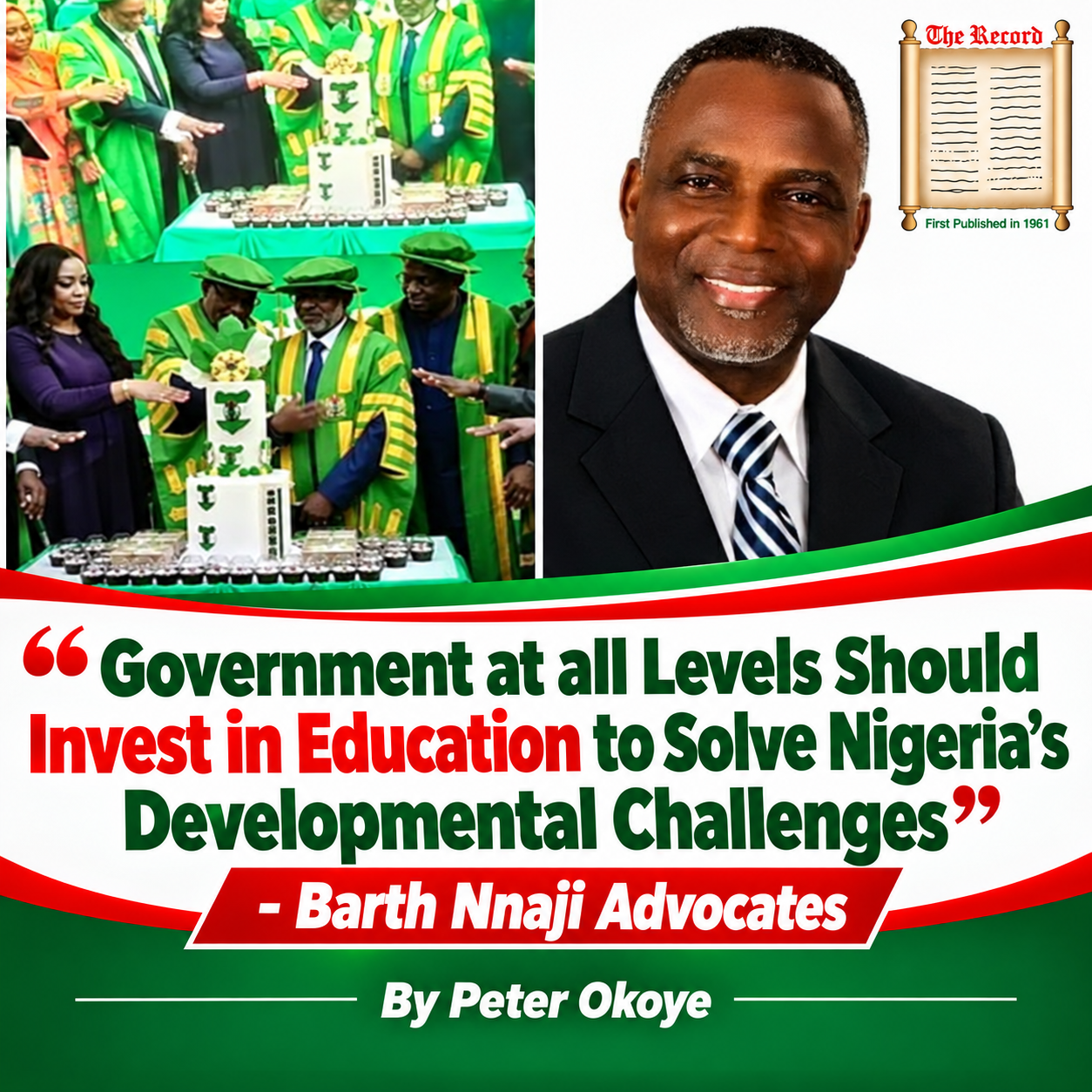
UNN – Former Minister of power, Prof. Barth Nnaji has called for increased investment in education at all levels, saying that adequate investment and funding in the sector is critical to building a globally competitive economy in the 21st century.
Nnaji made this call on Wednesday while delivering the University of Nigeria 66th Founders’ Day Lecture, titled, “21st-Century Development Challenges through Higher Education in Nigeria”, which was held at the Princess Alexandria Auditorium.
He said Nigeria could not achieve sustainable economic development without substantial investment in education to strengthen institutions, promote research and drive technological innovation.
The former minister urged governments at all levels to increase funding for education and promote strategic partnerships between universities and industries.
According to him, such partnerships would strengthen collaboration between the academic and business sectors while bridging the gap between classroom knowledge and the skills required in the workplace.
“I urge government at all levels to increase investments in education because records have shown that leading nations in economy and technology invest adequately in education.
“With adequate investments in education, universities will not only produce graduates but also become centres of innovation, research and technological advancement capable of providing solutions to the country’s economic and developmental challenges,” he said.
Nnaji, who is also Chairman of Geometric Power Group, stressed the need to prioritize Science, Technology, Engineering and Mathematics, STEM, education, noting that the future of the global economy increasingly depended on technological competence, innovation and the ability to develop home-grown solutions.
He urged Nigerians to believe in themselves and have confidence in the younger generation, saying Nigerian youths possessed the talent and intellectual capacity to compete favourably with their counterparts globally if given the necessary opportunities and support.
Nnaji also stressed the importance of competence and capacity in leadership, saying those entrusted with public responsibilities must possess the knowledge, ability and character required to deliver positive results.
“Nigeria needs leaders who will think strategically, take difficult decisions and deploy available resources effectively for the benefit of the people,” he said.
He, however, said Nigeria’s development challenges could not be addressed by government alone, urging universities, industries, professional bodies and other stakeholders to collaborate in developing the human capital required for national transformation.
Nnaji commended UNN for sustaining the Founders’ Day Lecture, noting that its founder, Dr Nnamdi Azikiwe, envisioned the institution as a world-class university with global standards and a mandate to provide comprehensive education for Nigerians.
He expressed appreciation to the university for finding him worthy to deliver the 66th Founders’ Day Lecture.
The Chairman of the occasion and former Vice-Chancellor of UNN, Emeritus Prof. Bartholomew Okolo, said the university’s founding was anchored on a vision to establish an institution capable of attaining the highest standards of academic excellence.
Okolo said the founding fathers of the university conceived a bold vision and mission that remained relevant to Nigeria’s development aspirations.
The former vice-chancellor commended the current administration of the university, led by Prof. Simon Ortuanya, for its infrastructure transformation and efforts to improve the physical and academic environment.
In his remarks, the Vice-Chancellor of UNN, Prof. Simon Ortuanya, said the Founders’ Day Lecture was instituted to commemorate the establishment of the university and honour the vision of its founder, Dr Nnamdi Azikiwe.
Ortuanya said the annual lecture provided a platform for intellectual discourse on national and global issues, while promoting the ideals of the university’s founding fathers, encouraging scholarship and critical thinking, and reflecting on the role of the university in Nigeria’s socio-economic development.
He said the best way to honour the founding fathers was not merely to celebrate their achievements but to sustain and advance the vision upon which the university was established.
“Let us honour the founding fathers by finishing what they began,” Ortuanya said.
Awards of recognition were presented to the widow of the late Dr. Nnamdi Azikiwe, Prof. Mrs. Uche Ewah Azikiwe, Prof. Barth Nnaji, and other distinguished guests present at the occasion.
Celebrating the 66th anniversary of the University of Nigeria, Nsukka, the institution has come a long way since it’s establishment in October 1955. The law establishing it was passed by the Eastern Nigeria Legislature on 18th May, 1955, but it became a reality on 7th October, 1960 – just 7 days after Nigeria’s independence. It was formally opened by Princess Alexandra of Kent.
The University of Nigeria, Nsukka (UNN) is Nigeria’s first indigenous and autonomous university. The first president of Nigeria, Dr. Nnamdi Azikiwe wanted a university modelled after the American system that would produce manpower for the new nation.
Nsukka, in present-day Enugu State was chosen because it was central in Eastern Nigeria and seen as a place with an ideal learning environment. The university adopted the American university system – 4-year system, General Studies (GS), Faculty system and started with 5 faculties and 220 students in 1960. The first Vice-Chancellor was an American academic named Dr. George Marion Johnson.
During the Civil War (1967-1970) it turned to the University of Biafra, was closed and occupied but reopened after the war. The school later expanded to four campuses: Nsukka, Enugu (UNEC – for professional courses like Medicine, Law), Ituku-Ozalla (Teaching Hospital), and Aba.
With it’s motto “To Restore the Dignity of Man”, today it is one of Nigeria’s 5 first-generation universities and remains one of the largest and most respected universities in Africa.