


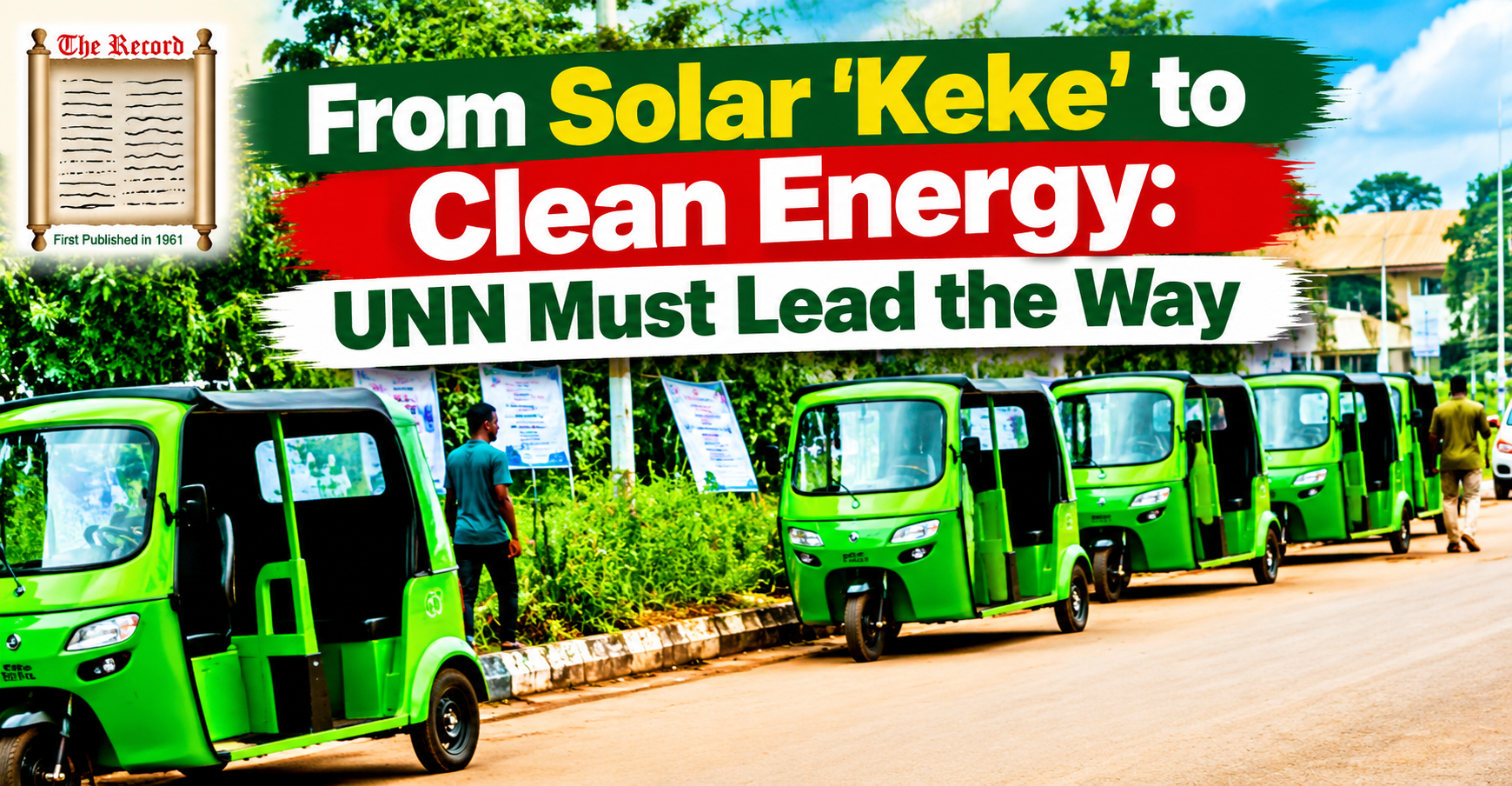
Nigeria cannot afford to treat the transition to cleaner energy as a distant policy objective. The country needs practical steps that connect national energy ambitions with the everyday lives of its young people. The solar-powered electric tricycles introduced at the University of Nigeria, Nsukka, provide one such opportunity!
According to the Federal Ministry of Information and National Orientation, the Federal Government’s Renewed Hope Campus Transport Scheme, launched in December 2025, deployed 240 solar-powered electric tricycles to 12 federal universities, including UNN. Each beneficiary university received 20 tricycles and a solar-powered charging station. The scheme was introduced to ease transportation challenges and provide students with affordable, cleaner mobility.
But the importance of the initiative should go beyond moving students around campus. Nigeria’s universities must now become active participants in the country’s clean-energy transition, and students must be prepared to participate in it.
According to Nigeria’s Energy Transition Plan, transport is that major sector requiring decarbonization and it’s he plan recognizes electric buses and two- and three-wheelers as part of the pathway towards cleaner mobility and sets a national target of net-zero emissions by 2060.
Universities are well placed to contribute to this objective. They are centres of research, innovation and professional training. Their students will become the engineers, entrepreneurs, policymakers, journalists and administrators who will shape the country’s energy future. It therefore makes sense for renewable-energy technology to be experienced not only in classrooms but also in the environments where students live and learn.
The solar-keke initiative can provide that practical exposure. UNN should connect the project to student research, energy education and entrepreneurship. Engineering students could investigate battery performance, charging systems and maintenance. Environmental students could examine its sustainability and environmental impact. Business students could study the economics of electric mobility, while Mass Communication students could translate energy policies and technical information into language that the wider public can understand.
This is important because Nigeria’s energy transition is also a communication challenge.
A policy that citizens do not understand is difficult to trust. Government and university authorities must communicate clearly about the cost, operation and benefits of such projects, continuously and not only at launch. Students should also have access to accurate information about fares, routes, maintenance and future expansion.
Public trust depends on institutional promises matching people’s actual experience. If a project is presented as affordable, students should experience affordability. If it is presented as sustainable, its infrastructure should be properly maintained. If students raise legitimate concerns, the appropriate response should be information and accountability rather than silence.
There are real challenges. According to the Energy Transition Plan, inadequate charging infrastructure, high initial costs and skills gaps are among the barriers to wider electric-vehicle adoption. These challenges, however, should push universities towards the research and training needed to solve them, not away from clean mobility.
There is already a precedent for linking renewable-energy infrastructure with higher education. The African Development Bank reported in February 2026 that Phase III of its Energising Education Programme was providing 36.5 MW of solar-hybrid capacity to eight Nigerian universities, alongside renewable-energy training opportunities for students. UNN is not among those eight institutions, but the programme demonstrates what is possible when energy infrastructure is connected to education and skills development.
UNN should not be left behind. It should build on the solar-keke initiative by encouraging wider renewable-energy projects, practical energy education and student participation. Government should equally support more universities with the infrastructure and technical capacity required to adopt sustainable transportation successfully.
The Student Union Government also has a role to play. Since the tricycles are intended to be operated by SUGs, student leaders should ensure that the service remains transparent and responsive to student needs. Students should have meaningful channels for feedback and access to information about how the scheme is being managed.
The objective should be bigger than another means of transportation. It should be a generation that understands, communicates and can contribute to Nigeria’s energy transition. That future will require more than policy; it will require informed young people, competent institutions, reliable infrastructure and public trust.
The solar keke at UNN should therefore be treated not as the destination, but rather as a beginning. Our Government and universities must build on it, expand sustainable-energy initiatives and give students the knowledge and opportunity to help build the clean-energy Nigeria we will all inherit.