


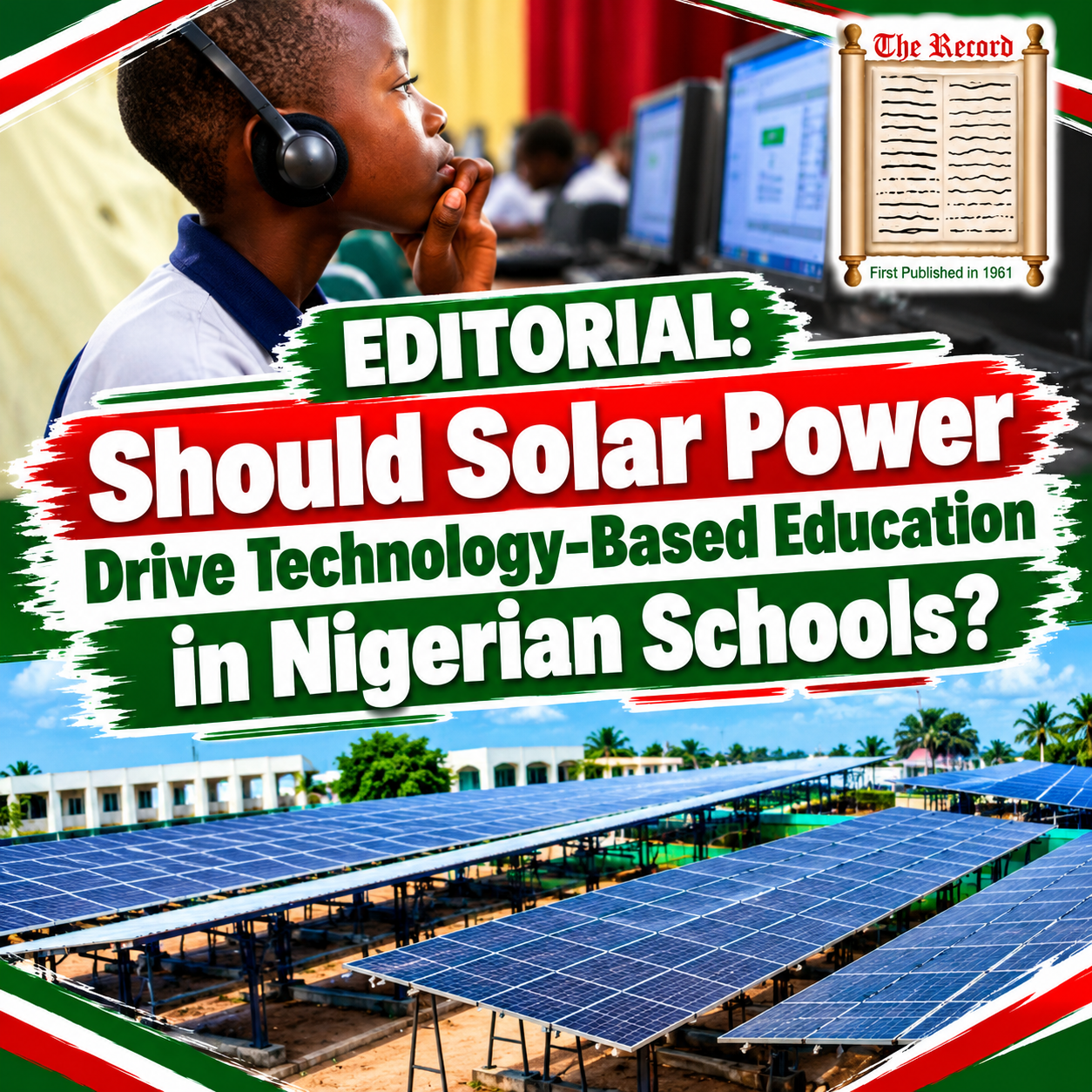
It is impossible to build a 21st-century digital economy on a 19th-century infrastructure. A generation ago, a blackboard and chalk were enough to run a classroom in Nigeria. Today, effective education requires functional computer labs, steady internet routers, and continuous power. Yet, schools across the nation are burning millions of Naira monthly on grid tariffs and generator fuel. Expecting university boards and school proprietors to raise globally competitive students on an unreliable public grid is a fantasy. To secure a sustainable future for technology-based education, Nigerian institutions must bypass the traditional power grid and transition to solar energy.
To understand why this transition is necessary, one must look at the contrast between our current power system and what true technological development requires. Today, Nigerian schools are crippled by unreliable electricity which is a system characterized by random blackouts and frequent national grid collapses. In contrast, reliable electricity means having guaranteed, uninterrupted power that flows consistently whenever a switch is flipped. For an ICT center, reliability is the difference between a student successfully submitting a digital exam or losing all their data due to a sudden outage. Moreover, solar offers a model of sustainable electricity because it relies on an infinite resource which is an abundant Nigerian sunlight. Unlike public power or generators, which suffer from a fragile supply chain and endless breakdowns, solar energy provides a steady foundation that keeps classrooms running indefinitely.
The crippling reality of our current energy crisis is felt most acutely when looking at the staggering financial drain on our tertiary institutions. Take the University of Nigeria, Nsukka (UNN) as a prime case study. Under current commercial tariff classifications, UNN’s expenditures across its campuses exceed an alarming ₦200 million every single month just to maintain basic operations. Over a single six-month academic semester, the university is forced to bleed roughly ₦1.2 billion into the hands of electricity distribution companies. Worse still, this grid dependency introduces a devastating financial disadvantage by which when institutions cannot keep up with these skyrocketing rates, they sink into debilitating debt. UNN’s grid reliance has historically saddled the institution with an unpaid electricity debt of over ₦600 million, triggering aggressive disconnection notices from the Enugu Electricity Distribution Company (EEDC). This unsustainable bleeding must stop. Solar energy directly counters this financial crisis by converting recurring monthly operational costs into a permanent capital investment, making the primary fuel source entirely free for decades while providing long-term budget predictability.
Why solar power makes sense becomes obvious when comparing the raw wattage required to run a high-tech campus. To keep research laboratories, campus-wide Wi-Fi routers, and desktop computer pools alive, a major institution like UNN requires a massive peak load capacity of roughly 10 megawatts (MW) of continuous power. When relying on the national grid, this wattage is notoriously unstable. Solar setups effortlessly solve this dilemma. Deployed globally, a utility-scale 10-megawatt solar installation requires an initial capital investment of approximately ₦25 billion to ₦27 billion Naira. While that upfront amount appears high, it can be seamlessly funded via state-backed allocations like the Federal Government’s ₦100 billion National Public Sector Solarization Initiative (NPSSI). Alternatively, through a Public-Private Partnership (PPP) contract, private solar developers can cover the initial construction costs entirely, and the educational organization simply pays a heavily discounted, predictable flat rate for the clean wattage generated. This setup effortlessly generates stable kilowatt-hours during peak school hours, completely free from grid transmission line losses.
We do not need to look far to see that this clean energy future is entirely achievable and real-world success stories are already taking root across Nigeria. Through the federal government’s Energising Education Programme (EEP), over two dozen federal tertiary institutions are successfully moving away from grid reliance. For instance, Yakubu Gowon University (formerly the University of Abuja) now operates round the clock on a state of the art solar farm generating 3.3 megawatts of daily electricity. Even more striking is the University of Maiduguri, which watched its crushing ₦200 million monthly grid electricity bill plummet to just ₦30 million after activating its hybrid solar installation. Recognizing this revolutionary blueprint, the Rural Electrification Agency (REA) has officially earmarked UNN as a priority beneficiary for its multi-billion Naira public sector solarization infrastructure rollout. These institutions serve as living proof that decentralized solar power is a highly functional system that slashes costs and is ready to be used nationwide.
Naturally, critics will argue that solar installations are far too expensive for underfunded public schools or low-cost private institutions. This objection, however, is fundamentally flawed and short-sighted. First, viewing solar as an “expense” ignores the massive long-term financial payoff. Paying a one-time structural installation cost is infinitely smarter than sinking into hundreds of millions of Naira grid debt with the EEDC. Furthermore, by utilizing the newly established Renewable Asset Management Company (RAMCO), government and private stakeholders can guarantee professional, long-term maintenance contracts that ensure these systems outlast traditional diesel generators by decades.
Nigeria is facing an energy crisis that has masqueraded as an educational crisis for far too long. We can design the most advanced technology-based curricula in West Africa, but they mean absolutely nothing if the classroom sockets are dead. Solar energy is no longer an alternative luxury.
If our school boards, state governments, and university governing councils continue to dump millions into grid debts and generator smoke, our youth will remain locked out of the global digital economy. The choice before us is clear. We must act now. The Federal Ministry of Education must immediately mandate a policy shifting school capital budgets away from grid spending and into renewable infrastructure. University governing councils must aggressively pursue partnerships with private solar developers, and corporate organizations must channel their corporate social responsibility (CSR) funds directly into solarizing local primary and secondary school computer labs. We must stop funding an outdated, collapsing grid and start investing in the sky.