


Nigeria’s electricity debate has reached a critical point. Sixteen State Electricity Regulatory Commissions (SERCs) have opposed aspects of the Electricity Act (Amendment) Bill 2026, arguing that it could weaken powers transferred to states by the 2023 reforms. The controversy raises a fundamental question: should Nigeria strengthen state electricity markets or return greater control to the Federal Government?
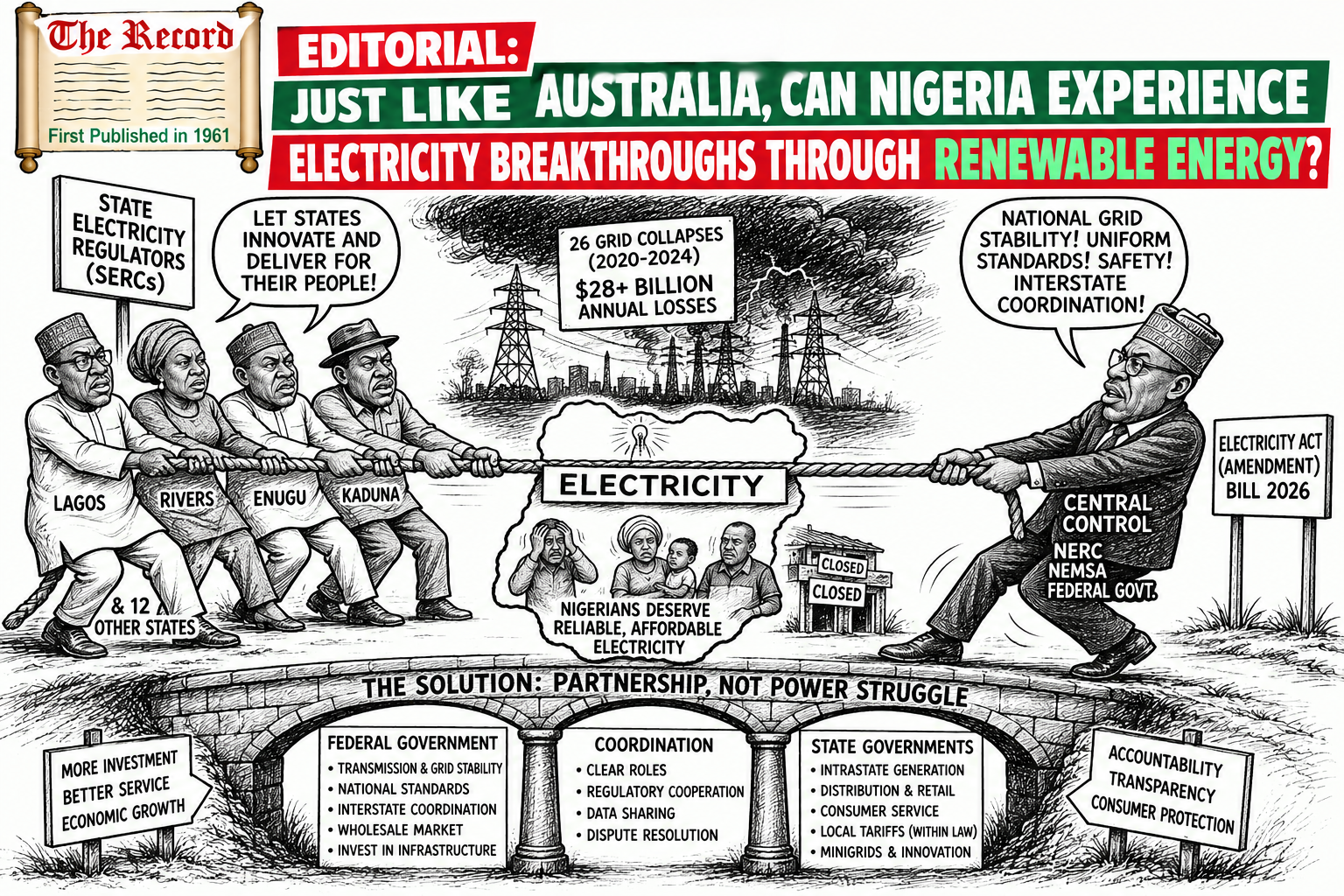
Nigeria’s experience with the national grid supports the case against excessive centralisation. Nigeria Electricity Regulatory Commission (NERC) recorded 26 system-collapse incidents between 2020 and 2024, including nine in 2024. Before the 2023 reforms, the grid had already suffered repeated failures. In July 2022, it reportedly collapsed to zero megawatts three times within hours, while another total collapse occurred in September 2023. These failures demonstrate the vulnerability of relying heavily on one interconnected system. The World Bank estimates that unreliable electricity costs Nigeria more than $28 billion annually through lost productivity, higher business costs and dependence on expensive self-generation.
The Electricity Act 2023 was therefore an important attempt to change Nigeria’s electricity architecture. It gave states greater authority over electricity generation, distribution, supply and retail within their territories and allowed them to establish electricity markets and regulators. The objective was not to abandon the national grid but to create additional, locally responsive routes to electricity supply.
Signs of this transition are already emerging. In December 2024, NERC transferred regulatory oversight of Lagos’s intrastate electricity market to the Lagos State Electricity Regulatory Commission (LASERC). By 2026, NERC reported that 15 states had assumed control of their electricity markets. Aba provides another practical example. The Geometric Power project, commissioned in 2024, combines generation and distribution to serve nine local government areas in Abia State, particularly an industrial area. Its development demonstrates how localised power systems can be designed around specific community and business needs rather than relying entirely on the national grid.
It would, however, be premature to claim that SERCs have already proved they physically repair faults faster than the Transmission Company of Nigeria (TCN). Most state regulators are too new for such a comparison. The stronger argument is that decentralisation brings regulation closer to consumers and creates local power systems that can be less vulnerable to national-grid failures. LASERC’s publication of federal level information on outages, reliability and service performance is an example of closer accountability.
The Federal Government’s concerns deserve recognition. Electricity networks cross state boundaries, while the national grid requires common technical, safety and operational standards. Interstate electricity transactions and the national wholesale market also require federal coordination. NERC and Nigerian Electricity Management Services Agency (NEMSA) therefore have legitimate national responsibilities. Nigeria should not replace one centralised system with 36 incompatible electricity markets.
However, the problem is not federal coordination but excessive federal control over matters that can be handled effectively at the state level. The SERCs have identified 17 contentious areas in the proposed amendment, including restrictions on State Houses of Assembly, federal control over grid-connected activities within states, expanded NERC powers, NERC appellate authority, wider NEMSA powers, restrictions on wholesale participation, federal influence over tariffs and consumer protection, and issues involving mini-grid licences and state regulatory powers.
The National Assembly should therefore amend, rather than reverse, the 2023 reforms. The Federal Government should retain responsibility for national transmission infrastructure, grid stability, interstate transactions and national technical and safety standards. NERC and NEMSA should coordinate with SERCs through clearly defined jurisdictions. The government must also invest in transmission infrastructure because decentralisation cannot replace a reliable national grid.
States must equally prove that autonomy will improve service. They should establish independent regulators, publish tariffs and outage statistics, protect consumers, provide effective complaint mechanisms, encourage private investment and prevent political interference or local monopolies.
Nigeria does not have to choose between the national grid and decentralised electricity markets. It needs both. The national grid should remain the backbone of the electricity system, while state markets, embedded generation and mini-grids provide alternative routes to power. After decades of repeated grid failures and billions of dollars in economic losses, Nigeria should not simply return to a model that has struggled to deliver reliable electricity. The National Assembly should protect decentralisation while strengthening national coordination, and judge both by one measure: whether Nigerians receive reliable, affordable and accountable electricity.