


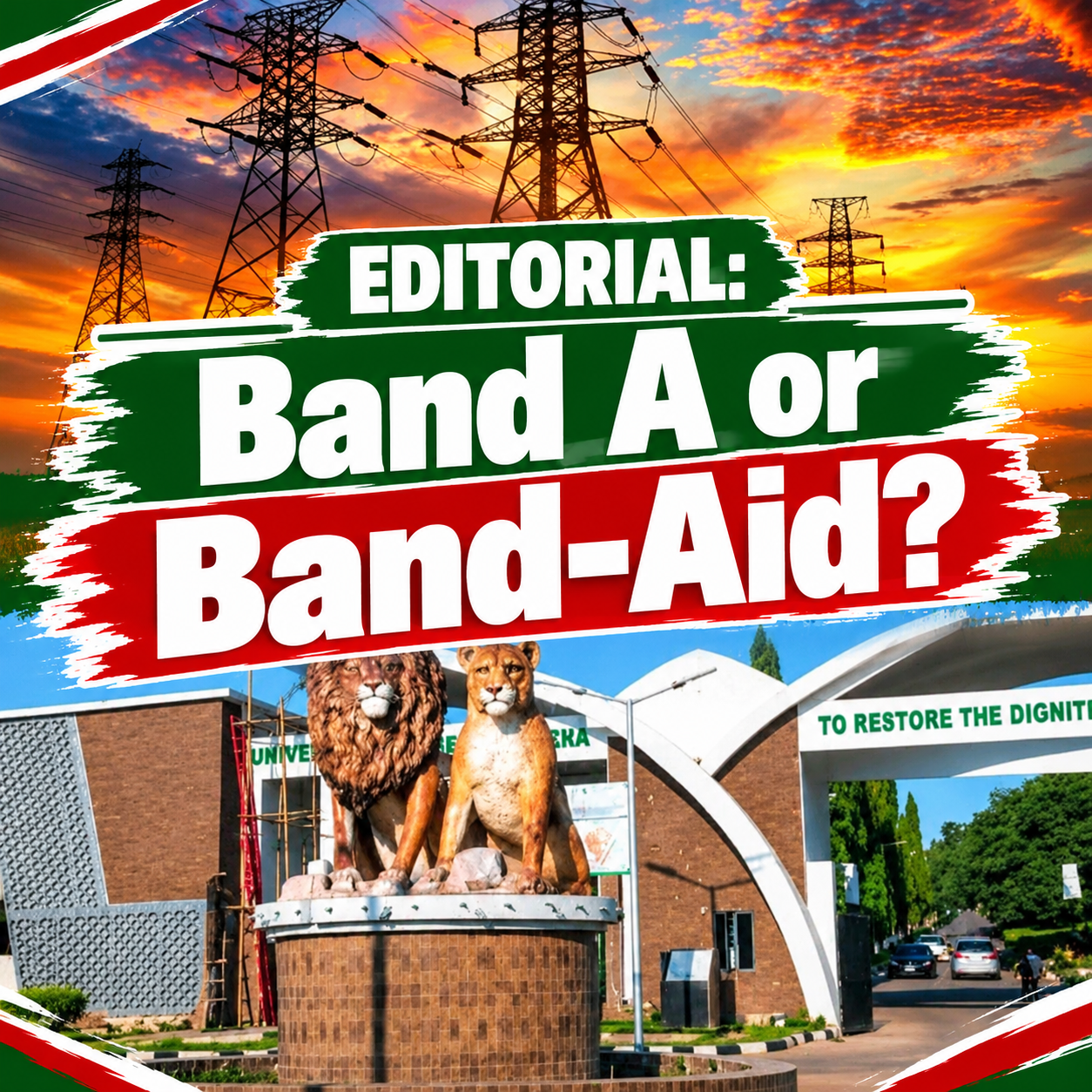
EDITORIAL: Band A or Band-Aid?
In finance, value for money is one of the simplest measures of a good investment. Consumers pay for a product or service with the expectation that what they receive matches what they paid for. That expectation lies at the heart of Nigeria’s Band A electricity tariff. Yet, at the University of Nigeria, Nsukka, the question remains whether the premium paid for electricity is producing premium service.
Electricity is the engine of a modern university. It powers classrooms, laboratories, internet services, research, businesses and communication. It keeps students connected to digital learning and enables the university to function efficiently. Beyond this, electricity has become a major financial responsibility. The more reliable the service expected, the more consumers are required to pay. This is why the electricity situation at UNN deserves serious attention. It is not only an energy issue but also a question of whether the money being paid matches the service being received. Nigeria’s electricity tariff operates on a Service Based Tariff system introduced by the Nigerian Electricity Regulatory Commission (NERC).
Consumers are grouped into Bands A to E according to the average number of hours of electricity they are expected to receive daily. Band A customers are entitled to a minimum of twenty hours of electricity every day after payment of ₦209.50 per kilowatt-hour (kWh).
UNN falls under this Band A classification through the Enugu Electricity Distribution Company (EEDC). On paper, that is good news. In reality, however, many members of the university community may be forgiven for wondering whether the “A” stands for Abracadabra. The recent convocation period illustrates this concern. As the university welcomed distinguished guests and celebrated another graduating class, many hostels, departments and other parts of the campus experienced prolonged power outages. For a university classified under Band A, such a situation naturally raises questions. Students have also become accustomed to electricity becoming strangely unreliable around examination periods. Whether this is coincidence or the result of technical challenges, the recurring nature of the problem deserves explanation rather than silence.
The consequences extend beyond inconvenience. Students struggle to charge their phones and laptops. Online research is interrupted. Lecturers cannot fully utilise digital teaching tools. Businesses spend more on fuel for generators and other alternative power sources. Even the simple task of reading at night becomes a negotiation between candlelight, rechargeable lamps and hope.
We recognise that electricity distribution is not without challenges. Faults occur. Infrastructure fails. The national grid remains very far from perfect. However, these realities cannot become permanent explanations for inconsistent service where premium tariffs are being charged.
At The Record Online, we maintain that the principle behind Band A is sound. Those who pay for premium electricity should receive premium electricity. If that standard cannot be consistently met, the university community deserves honest communication about why, what is being done and when improvement can be expected.
We therefore urge the Enugu Electricity Distribution Company to strengthen service delivery to the university in line with its Band A obligations. We also encourage the university management to engage more actively with the electricity provider and keep the university community informed of ongoing efforts to improve supply. In the long term, UNN should invest more aggressively in sustainable alternatives such as solar power for critical facilities to reduce dependence on an increasingly unreliable national grid. UNN proudly bears the motto, To Restore the Dignity of Man. Reliable electricity may not restore dignity on its own, but it certainly helps students submit assignments, researchers complete their work and businesses stay afloat.
Our position is simple. Band A must mean something. If consumers are paying for twenty hours of electricity, they should not have to celebrate two. Until service matches the promise, the brightest thing about Band A will remain the bill.